Teaching Kids to Budget

Budgeting is a skill, and like reading or riding a bike it is easiest to learn in small steps with a grown-up nearby. Kids do not need spreadsheets. They need a little money of their own, a simple plan, and the freedom to make small mistakes while the stakes are low.
Why start young?
Money habits form early. Children who practice waiting for something, comparing prices, and choosing between two things they want are building the same muscles adults use to manage a paycheck. And a mistake with five dollars of allowance is far cheaper than the same mistake with a first credit card.
What to teach at each age
| Age | Focus | Try this |
|---|---|---|
| 3 to 5 | Money is traded for things | Let them hand coins to a cashier. Play store at home with play money. |
| 6 to 8 | Choosing and waiting | Start save, spend, and share jars. Set a small goal that takes three or four weeks to reach. |
| 9 to 12 | Planning ahead | Give a weekly amount that covers some of their own costs. Have them write a simple plan before they spend. |
| 13 and up | Real-life categories | Hand over a clothing or phone budget for a season. Let them track it and own the result. |
Save, spend, share: the simplest budget there is
Three clear jars are a budget a six-year-old can see. Every time money comes in, your child splits it before spending anything. Saving gets the biggest share, spending gets enough to feel fun, and sharing builds generosity. Use real coins, or print family bank money in the play money creator.
How small habits add up
The most eye-opening budgeting lesson for kids is seeing how a small, repeated purchase grows over time. Work through a table like this together, then make one for something your child actually buys.
| Habit | Each time | Per week | Per year |
|---|---|---|---|
| A snack after school, 3 days a week | $2 | $6 | $312 |
| A small toy every Saturday | $5 | $5 | $260 |
| A grown-up's coffee, 5 days a week | $5 | $25 | $1,300 |
| A grown-up's lunch out, 5 days a week | $12 | $60 | $3,120 |
Then ask: "What else could $312 buy?" The point is not that snacks are bad. It is that every repeated choice has a yearly price tag, and knowing it lets you decide on purpose.
Let them make (small) mistakes
When your child spends all of their money on something that breaks the next day, resist the urge to replace it. Instead, ask a few gentle questions: Was it worth it? What would you do differently? Those few minutes teach more than any lecture.
Practice with a pretend store
Set up a store at home with price tags on toys, books, and snacks. Give your child a fixed amount of play money and a short shopping list with more items than they can afford. They will have to choose, add up prices, and maybe put something back. It is a budget in miniature.
Free printable: My Money Plan
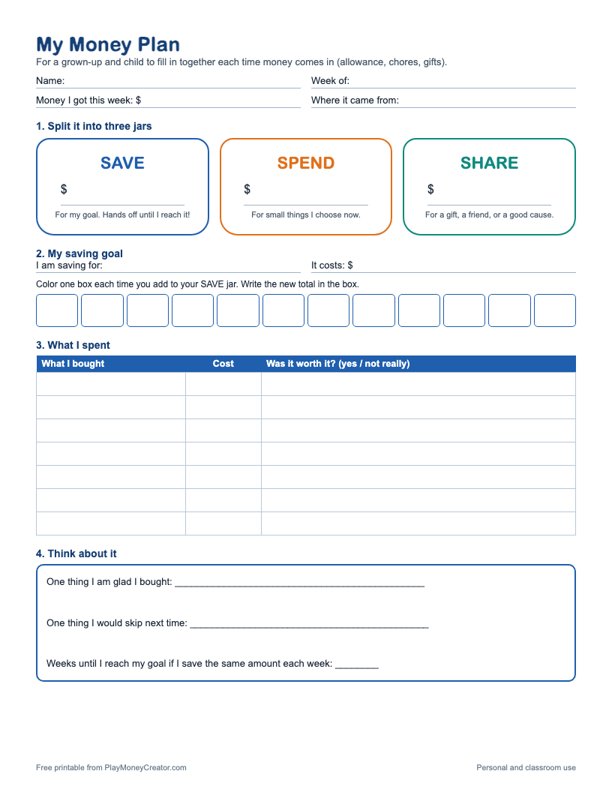
A one-page sheet for a grown-up and child to fill in together each time money comes in: split it into save, spend, and share, color in progress toward a goal, and look back at what was worth it.
Free for personal and classroom use. Letter size, one page.
For your own household budget, see budgeting basics and the free family worksheet.
This page is general education for families and classrooms, not personal financial or investment advice. Example numbers are for illustration only.
Frequently asked questions
At what age should a child get an allowance?
Many families start between ages 5 and 7, once a child can count and understands that money is traded for things. Starting with play money in a family bank works well even earlier.
Should I control what my child buys?
Set a few clear limits, such as safety and family values, then let them decide within those limits. The choices are where the learning happens.
What should go in the share jar?
Anything that helps someone else: a donation, a gift for a sibling, or a contribution to a cause your child cares about.