Budgeting Basics: Why a Budget Matters

A budget is a plan for your money made before you spend it. That is all. It is not a punishment or a list of things you cannot have. It is a way to make sure your money goes to what matters most to you, and it is one of the best habits children can watch their parents practice.
Why budgeting matters
- You see where money goes. Most people are surprised by at least one category the first month they track it.
- Fewer surprises. Bills that come once or twice a year, like car registration or school fees, stop being emergencies when you plan for them.
- Goals become reachable. A vacation, a new bike, or an emergency fund turns from a wish into a monthly line item.
- Less stress. Knowing you have enough for the month makes day-to-day spending easier, not harder.
- Kids learn by watching. Children who see adults plan, compare prices, and wait for things are more likely to do the same.
Make your first budget in six steps
- Write down your monthly income. Use take-home pay, the amount that actually reaches your account.
- List fixed bills. Rent or mortgage, utilities, phone, insurance, car payment, childcare, and debt payments. These stay about the same each month.
- Estimate everyday spending. Groceries, gas, eating out, clothing, activities, and fun. Look at the last two months of statements for real numbers.
- Pay yourself. Add savings as a line, even a small one. Treat it like a bill.
- Subtract. Income minus everything else. If the result is below zero, trim an everyday category. If it is above zero, give the extra a job.
- Track and adjust. At the end of the month, fill in what you actually spent. The goal is to learn, not to be perfect.
Free printable: family monthly budget worksheet
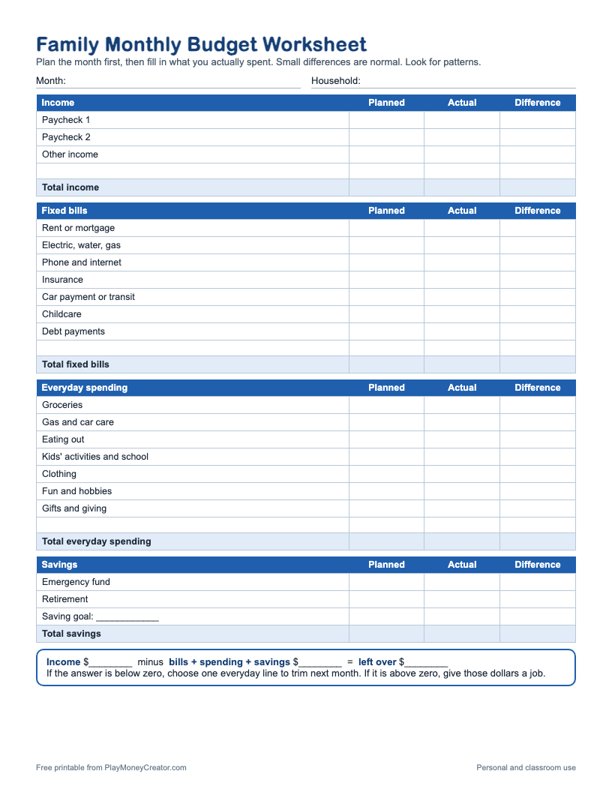
A one-page worksheet with planned, actual, and difference columns for income, fixed bills, everyday spending, and savings. Print one each month and keep them in a folder so you can see your progress.
Download the budget worksheet (PDF)
Free for personal and classroom use. Letter size, one page.
Three popular ways to budget
Every dollar gets a job
Assign all of your income to categories until there is nothing left unassigned. Savings counts as a category. This approach gives the most control and works well when money is tight.
Needs, wants, and savings
Divide spending into three big buckets instead of many small categories. A commonly quoted guideline is about half for needs, up to a third for wants, and at least a fifth for savings and paying down debt. Treat it as a starting point, since housing costs alone can make the needs bucket bigger in many areas.
Cash envelopes
Put cash for flexible categories, such as groceries or fun, into labeled envelopes at the start of the month. When an envelope is empty, that category is done. It is old fashioned and very effective, and it is easy for kids to understand. Read why cash is such a good teacher.
Common budgeting mistakes
- Forgetting irregular bills. Divide yearly costs by 12 and save that amount each month.
- Making it too strict. A budget with no fun money rarely lasts. Include a small amount you can spend freely.
- Not tracking. A plan you never compare to real spending is only a guess.
- No cushion. Even a small emergency fund keeps one surprise from breaking the whole plan.
Bring the kids in
Children do not need to see every number, but they benefit from hearing how decisions are made: "We are eating at home this week because we are saving for the beach trip." When they are ready to budget their own money, start with our guide to teaching kids to budget and its free kids' worksheet.
This page is general education for families and classrooms, not personal financial or investment advice. Example numbers are for illustration only.
Frequently asked questions
How long does it take to make a first budget?
About an hour with your recent bank statements nearby. Updating it each month takes 15 to 20 minutes.
What if my income changes every month?
Budget using your lowest typical month. In better months, put the extra toward savings or upcoming bills.
Is the worksheet free to share?
Yes, for personal and classroom use. Please link to this page rather than posting the PDF elsewhere.