Money Math for Kids: Fun Ways to Teach With Play Money
Money may be the most motivating math manipulative there is. Children who yawn at a worksheet will happily count a pile of dollars that are "theirs." Play money turns adding, subtracting, skip counting, place value, and even decimals into games you can play at the kitchen table.
What money teaches
| Math skill | How money practices it |
|---|---|
| Counting and skip counting | Counting by 1s, 5s, 10s, and 25s with bills and coins |
| Addition and subtraction | Adding up prices, figuring out how much is left |
| Place value | Ten $1 bills equal one $10 bill; ten $10 bills equal one $100 bill |
| Decimals | Cents as hundredths of a dollar: $1.25 is one dollar and 25 hundredths |
| Multiplication | Three toys at $4 each, or six bills of $5 |
| Problem solving | Making change, finding the best deal, staying within a budget |
Know your coins
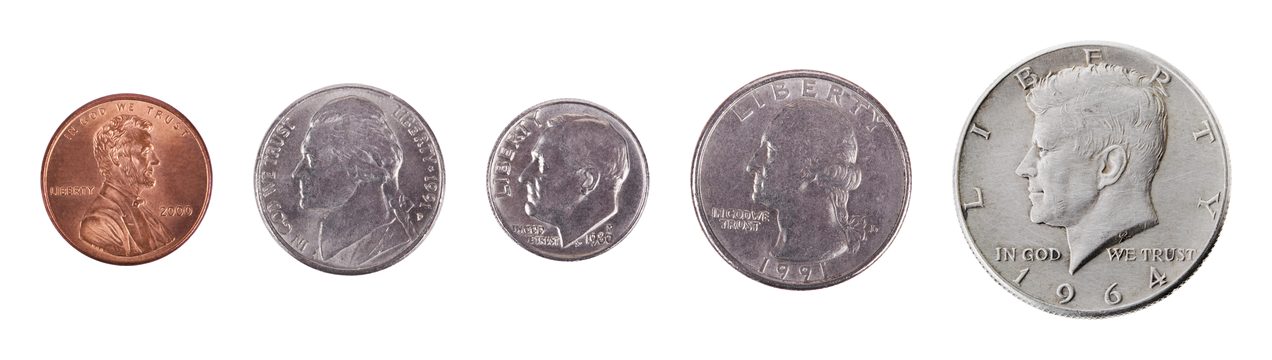
Start by naming each coin and its value. Size does not always match value (the dime is the smallest coin but worth more than a penny or a nickel), which is a fun surprise for young learners.
| Coin | Value | How many make $1 |
|---|---|---|
| Penny | 1 cent | 100 |
| Nickel | 5 cents | 20 |
| Dime | 10 cents | 10 |
| Quarter | 25 cents | 4 |
| Half dollar | 50 cents | 2 |
Activities by age
Ages 4 to 6
- Sort and count. Sort a mixed pile of coins and bills by type, then count each pile.
- Match the price. Put price tags of 1 to 10 dollars on toys. Your child pays with $1 bills.
- Which is more? Hold up two piles of bills. Which pile has more money? How do you know?
Ages 6 to 8
- Make a dollar four ways. Use coins to make exactly one dollar in four different ways.
- Pretend store with change. Prices under 20 dollars, payment with a $20 bill, and your child works out the change.
- Skip count race. Count a stack of $5 bills by fives, then a stack of $10 bills by tens. Time it, then try to beat it.
Ages 8 to 11
- Restaurant menu. Write a menu with prices like $3.75 and $6.50. Your child orders for the family, adds it up, and pays.
- Budget shopping list. Give 50 dollars and a store flyer. Plan a meal for four without going over.
- Trade up. Start with 100 one-dollar bills and trade up to the fewest bills possible. It is place value you can hold.
Make a custom place value set
Most play money sets stop at $20 or $100. With the play money creator you can print any value from 1 to 1,000,000, which makes it perfect for place value. Print $1, $10, $100, and $1,000 bills in four different colors, and let your child build numbers: 3,452 is three $1,000 bills, four $100 bills, five $10 bills, and two $1 bills. Add your child's face to each value for extra motivation.
Turn it into a game
Many money activities become games with one small change: a timer, dice, or a goal. Roll two dice and collect that many dollars, first to 50 wins. Draw cards with prices and race to pay the exact amount. Play "bank teller," where your child must give change using the fewest bills and coins possible.
Practice online too
For extra practice on a screen, our sister site MoneyCountingGames.com has free games for counting coins and bills and making change. They pair well with hands-on play money: count the real thing at the table, then practice the same skill on screen. We suggest playing alongside your child so you can talk through each answer together.
More ideas: printable sets and activity guides at PrintableKidsPlayMoneyTemplates.com.
This page is general education for families and classrooms, not personal financial or investment advice. Example numbers are for illustration only.
Frequently asked questions
What age should kids start learning about money?
Children can start sorting and naming coins around age 4. Counting mixed coins and making change usually comes between ages 6 and 8.
Why is counting coins hard for kids?
Coins break the pattern kids expect: bigger is not always worth more, and switching from counting by 25 to counting by 10 takes practice. Sorting coins first helps.
Should I use real coins or play money?
Both. Real coins help kids recognize what they will see at the store, and play bills let you print any value, including place value sets.